

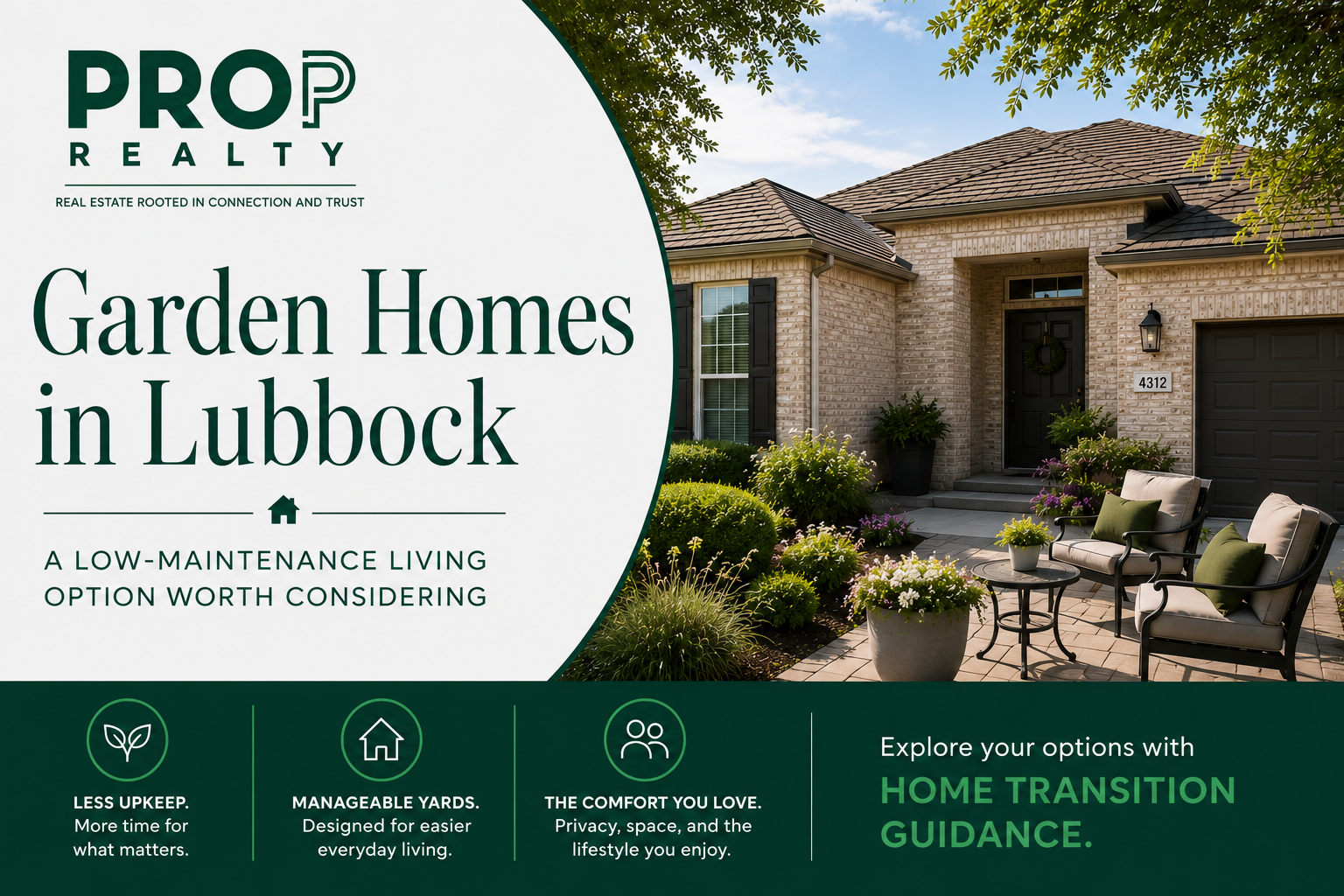
Garden Homes in Lubbock: A Low-Maintenance Living Option Worth Considering
For many Lubbock homeowners, the idea of moving is not really about finding a smaller house.
It is about finding a home that asks less of them.
After years of mowing, watering, repairing fences, trimming trees, maintaining irrigation systems, and keeping up with rooms that are no longer used every day, some homeowners begin to wonder whether there is another way to live.
They may still want a private home. They may still want a garage, guest room, comfortable living space, and an outdoor area where they can sit in the evening. They may want room for family to visit and enough storage for the belongings that matter.
What they may not want is a large yard, an aging exterior, or a growing list of weekend projects.
That is where garden homes often enter the conversation.
A garden home can offer many of the features people appreciate about a traditional detached home while reducing some of the exterior responsibilities that come with a larger property. In Lubbock, where long summers, wind, irrigation needs, dust, and seasonal weather can make yard care a significant commitment, that difference can be meaningful.
Our team at PROP Realty includes a Senior Real Estate Specialist who helps homeowners and families evaluate housing choices through our Home Transition Guidance in Lubbock. Garden homes are one option we may discuss, but they are not automatically the right choice for every homeowner.
The purpose of this guide is to explain what garden-home living actually looks like, where these properties may be found in Lubbock, and what buyers should examine before deciding whether this lifestyle fits their goals.
Key Takeaways
- A garden home is usually a detached single-family home on a smaller lot, although the exact definition can vary by neighborhood and listing.
- Garden homes may reduce yard work, but buyers should verify exactly what the homeowner and homeowners association are responsible for maintaining.
- Lubbock garden homes can be found in established and newer areas, including sections of southwest and south Lubbock.
- Single-story living, manageable outdoor space, storage, parking, accessibility, and location are often more important than square footage alone.
- A garden home should be evaluated as part of a broader home transition plan rather than treated as the only path toward lower-maintenance living.
What a Garden Home Means in Lubbock
The term “garden home” does not always describe one exact architectural style.
In Lubbock real estate, it commonly refers to a detached single-family home built on a smaller or more compact lot. The home may sit closer to one or more property lines than a traditional house, leaving less lawn and less exterior space to maintain.
Many garden homes include a private patio, courtyard, side yard, or enclosed outdoor area rather than a large backyard. Some are located in neighborhoods developed specifically around this type of housing. Others are found in a garden-home section within a larger subdivision.
The houses themselves can vary widely.
Some are modest in size and designed around simple, efficient living. Others are custom homes with generous bedrooms, offices, formal dining areas, large garages, luxury finishes, and substantial interior square footage.
This is one of the most important things for Lubbock homeowners to understand. A garden home is not necessarily a small home.
It is often a home that uses its lot differently.
The outdoor area may be more contained. The landscaping may be concentrated near the entrance, patio, or courtyard. The design may place a greater emphasis on indoor living space while reducing the amount of yard that requires regular attention.
For a homeowner who still wants privacy and ownership but would prefer fewer exterior responsibilities, that layout can be appealing.
Garden Homes and Patio Homes Are Often Similar
In Lubbock, the terms “garden home” and “patio home” are sometimes used interchangeably.
One listing may describe a property as a garden home, while another similar property may be called a patio home. Some neighborhoods or homeowners associations may use a specific term in their documents, while agents and homeowners use a different term in everyday conversation.
Rather than relying on the label alone, buyers should look at the actual property.
Important questions include:
- Is the home detached or attached?
- Who owns the land beneath and around the home?
- How large is the lot?
- How close is the home to neighboring structures?
- Who maintains the front yard, side yard, alley, fencing, roof, and exterior?
- Is there a homeowners association?
- What do the association dues cover?
Two homes marketed with the same label may offer very different responsibilities.
One community may include front-yard maintenance through the homeowners association. Another may require each owner to care for all landscaping. A third may maintain common spaces but leave the home, patio, fencing, and yard entirely to the homeowner.
The name of the housing type provides a starting point. The governing documents and physical layout provide the details.
Why Garden Homes Appeal to Lubbock Homeowners
Garden homes appeal to different people for different reasons.
Some homeowners are preparing for retirement and want a property that will be easier to manage. Some travel frequently and do not want to arrange extensive lawn care every time they leave town. Others are still working and simply prefer spending their time away from home maintenance.
A garden home can also appeal to someone who has lived on a large lot for many years and is ready for a change without giving up the privacy of a detached house.
In Lubbock, the local environment adds another layer to the decision.
Yard care can involve more than mowing. Homeowners may manage watering schedules, irrigation repairs, dry conditions, windblown debris, weeds, trees, flower beds, fences, and heat-related stress on landscaping.
A smaller outdoor footprint does not eliminate all of those concerns, but it may reduce the area that needs attention.
That can mean fewer hours spent edging sidewalks, adjusting sprinkler heads, cleaning large patios, replacing plants, or coordinating yard work.
For some homeowners, the value is not simply lower maintenance. It is greater freedom.
It may be easier to leave for a weekend, spend time with grandchildren, travel, volunteer, or enjoy hobbies when the property requires less ongoing attention.
Garden Homes Are About Lifestyle, Not Age
Garden homes are often discussed in connection with retirees, empty nesters, or homeowners planning for the future.
Those groups may appreciate them, but garden homes are not exclusively for older adults.
A busy professional may prefer a smaller yard. A frequent traveler may value a more manageable property. A couple without children at home may want quality interior space without maintaining a large lot. Someone relocating to Lubbock may want to live near shopping, medical care, restaurants, or family while keeping exterior responsibilities limited.
The more useful question is not whether someone is the “right age” for a garden home.
The better question is whether the property supports the way that person wants to live.
A homeowner who enjoys gardening, outdoor entertaining, pets, or having grandchildren play in a large backyard may prefer a traditional lot. Another homeowner may be completely satisfied with a courtyard, small patio, or carefully landscaped side yard.
Neither choice is better in every situation.
The right fit depends on how the outdoor space will actually be used.
What a Day in Garden-Home Living Can Feel Like
Imagine waking up in a single-story home where the rooms you use most are easy to reach.
The kitchen opens to the living area. A guest room is ready when family visits. There is a separate office or hobby room, but there are not several unused bedrooms to clean and maintain.
Outside, the patio has enough room for a table, a few planters, and a comfortable chair. The yard is small enough to care for without giving up an entire morning. Depending on the community, part of the landscaping may be handled through the homeowners association.
You can leave for several days without worrying about a large lawn getting out of control. When you return, the home still feels private and familiar.
That is the appeal many people imagine when they consider a garden home.
Of course, the experience depends on the individual property.
A west-facing patio may receive intense afternoon sun. A narrow side yard may not work well for a large dog. Limited guest parking may become frustrating during family gatherings. A smaller garage may not accommodate vehicles, tools, seasonal decorations, and hobby equipment.
The lifestyle can be comfortable and practical, but only when the home’s details match the homeowner’s daily routines.
Where Garden Homes Can Be Found in Lubbock
Garden homes are not limited to one neighborhood or one part of Lubbock.
They can appear in sections of established neighborhoods, planned communities, newer developments, and areas where builders created smaller-lot housing alongside traditional homes.
Buyers may encounter garden homes in parts of southwest and south Lubbock, including the broader LakeRidge area and LakeRidge South. Highland Gardens is another local area associated with this type of housing.
Individual garden homes can also appear in other subdivisions and pockets of the city, depending on how a property was designed and marketed.
Availability can be limited because garden-home sections are often smaller than traditional subdivisions. A neighborhood may have only a handful of active listings at a given time, and some properties may not use the words “garden home” in the listing even when the layout offers similar benefits.
This is why buyers should search by both housing type and features.
A search may include terms such as:
- Garden home
- Patio home
- Zero-lot-line home
- Small-lot home
- Low-maintenance yard
- Courtyard home
- Single-story home
- HOA-maintained landscaping
It is also useful to search based on practical priorities rather than terminology alone.
A homeowner may care more about having one level, a manageable yard, a two-car garage, a guest room, and access to medical care than whether the listing formally calls the property a garden home.
Our Home Transition Guidance process helps homeowners identify those priorities before beginning a property search.
Features Worth Prioritizing in a Lubbock Garden Home
The most attractive feature in a listing is not always the most important feature for everyday living.
Granite countertops, decorative ceilings, fireplaces, and attractive landscaping may catch your attention. The long-term fit often depends on quieter details.
A Single-Story Layout
Many homeowners exploring low-maintenance living prefer a home without stairs.
Single-story living may make daily movement easier and reduce concerns about carrying laundry, groceries, or household items between floors.
Even in a one-story home, buyers should look for steps at the entry, garage, patio, and shower.
Accessible Bathrooms
A spacious bathroom does not automatically mean an accessible bathroom.
Consider shower entry, floor transitions, doorway width, lighting, and the amount of open space around fixtures.
A beautiful soaking tub may be appealing, but a walk-in shower may provide greater long-term usefulness.
Useful Storage
Moving to a smaller lot does not mean belongings disappear.
Look carefully at closets, pantry space, garage storage, attic access, linen storage, and room for holiday decorations or hobbies.
A home with efficient storage may feel more comfortable than a larger home with poorly planned closets.
Garage and Parking Space
Garden-home lots can be compact, which may affect driveways and guest parking.
Confirm whether the garage comfortably fits your vehicles. Consider where visitors will park and whether neighborhood rules limit street parking.
For homeowners with trucks, golf carts, workshop equipment, or mobility devices, garage dimensions can be especially important.
Patio Direction and Shade
Outdoor space should be evaluated at different times of day.
A west-facing patio may feel very different in late afternoon than it does during a morning showing. Shade structures, mature landscaping, fencing, and nearby buildings can all affect comfort.
Also consider wind exposure, drainage, privacy, and how much direct sun reaches plants and seating areas.
Heating, Cooling, Roofing, and Windows
A smaller yard does not automatically make the entire property low maintenance.
The age and condition of the roof, heating and cooling system, windows, plumbing, electrical components, and exterior materials still matter.
A well-designed garden home with aging systems may require more near-term investment than a traditional home with updated components.
The Homeowners Association Deserves Careful Review
Many garden-home neighborhoods have a homeowners association, but the level of service varies.
One association may maintain common areas only. Another may include front-yard mowing or seasonal landscaping. Some may manage gates, private streets, exterior lighting, or shared amenities.
Buyers should not assume that “low maintenance” means the association handles every exterior task.
Before purchasing, review:
- Current dues and how often they are paid
- What services are included
- Which portions of the yard belong to the homeowner
- Who maintains fences, roofs, exterior walls, alleys, and driveways
- Rules for exterior changes
- Pet restrictions
- Parking rules
- Rental restrictions
- Financial statements and reserves
- Recent or proposed special assessments
- Insurance responsibilities
A community with higher dues may provide services a homeowner values. Another buyer may prefer lower dues and greater control over the property.
The important point is knowing what the payment covers and whether the arrangement supports your priorities.
Potential Tradeoffs of Garden-Home Living
Garden homes can provide meaningful advantages, but they also involve tradeoffs.
Smaller lots may place homes closer together. That can affect privacy, natural light, noise, and how open the outdoor space feels.
There may be less room for children, pets, gardening, outdoor games, or large gatherings. Guest parking may be more limited. Association rules may place restrictions on fencing, exterior paint, landscaping, vehicles, or additions.
Some garden homes have generous interior space but limited storage. Others may have an efficient floor plan but no room for a home office or overnight guests.
Resale can also depend on how many buyers are seeking that specific lifestyle at the time the home is listed.
These concerns do not make garden homes a poor choice.
They are simply part of the comparison.
A good housing decision considers both the responsibilities a homeowner wants to leave behind and the features they do not want to lose.
Questions to Ask Before Buying a Garden Home
A garden home should be evaluated with the same care as any other property, along with several questions specific to compact-lot living.
- Exactly which parts of the property am I responsible for maintaining?
- What do the homeowners association dues cover?
- How much privacy does the patio or courtyard provide?
- Does the outdoor area receive comfortable morning or evening shade?
- Is there enough guest parking?
- Will the garage fit my vehicles and storage needs?
- Are there steps at any entrance or between living areas?
- Does the bathroom layout support future accessibility?
- Are the bedrooms, office, laundry room, and storage areas easy to reach?
- How old are the roof, heating and cooling system, windows, and major appliances?
- Are pets, rentals, exterior changes, or additional structures restricted?
- Is the home close to the people and places I visit regularly?
- Does the home still provide enough room for family, hobbies, and everyday routines?
These questions help move the conversation beyond appearance.
The goal is not simply to find an attractive garden home. It is to find a home that will remain practical after the excitement of the purchase has passed.
A Garden Home Is One Part of a Larger Home Transition
For homeowners considering a change, the first step is not always touring properties.
The more useful starting point may be understanding what is no longer working in the current home.
Is the concern yard maintenance, stairs, repairs, distance from family, unused space, utility costs, travel, or a combination of several things?
Once those priorities are clear, it becomes easier to compare the available paths.
A homeowner may discover that hiring yard care or making a few improvements allows them to stay comfortably. Another may prefer a newer traditional home with a smaller lot. Someone else may decide that a garden home provides the right balance of privacy, space, and manageable upkeep.
Our team at PROP Realty uses Home Transition Guidance for Lubbock homeowners to help compare staying, renovating, preparing a home for sale, selling as-is, and moving to another type of property.
The right answer is not determined by age, square footage, or what other people are doing.
It is determined by the homeowner’s goals, finances, routines, family needs, and preferred timeline.
How a Senior Real Estate Specialist Can Help
Our team at PROP Realty includes a Senior Real Estate Specialist, or SRES®, who has completed additional education related to the housing needs and real estate decisions of older adults.
That perspective can be valuable when a move involves more than choosing a home.
The conversation may include:
- Whether the current home can be adapted
- How to compare renovation costs with moving costs
- Which home features may support future needs
- How to coordinate a sale and purchase
- How family members can participate constructively
- Whether a traditional sale or as-is option better fits the situation
- How to create a realistic timeline
- Which Lubbock housing types align with the homeowner’s priorities
A Senior Real Estate Specialist does not make the decision for the homeowner.
The role is to provide context, explain options, identify practical concerns, and help the homeowner move forward with greater clarity.
For some people, the result will be a garden home. For others, it will be a different property or a decision to stay where they are.
You can learn more about how our team helps homeowners evaluate important home decisions before deciding which path is right for you.
Frequently Asked Questions
Are all garden homes located in age-restricted communities?
No. A garden home describes a housing style or lot arrangement, not an age restriction. Some communities may have specific occupancy rules, but many garden-home neighborhoods are open to buyers of different ages.
Do garden homes always have homeowners association dues?
No. Many garden-home communities have an association, but not every property does. When an association is present, buyers should review the dues, services, restrictions, financial condition, and maintenance responsibilities before purchasing.
Can a garden home still have three bedrooms and a large garage?
Yes. Garden homes vary considerably. Some offer several bedrooms, offices, large living spaces, and two-car or three-car garages. The term usually relates more to the compact lot and reduced yard area than to a specific interior size.
Are garden homes easier to maintain than traditional homes?
They may require less yard work because the lot is smaller, but the overall maintenance depends on the property’s age, construction, systems, exterior materials, landscaping, and association services. Buyers should evaluate the entire home rather than assuming the label guarantees low upkeep.
How can I know whether a garden home fits my long-term plans?
Consider accessibility, storage, parking, outdoor space, association responsibilities, proximity to family and healthcare, and the amount of maintenance you want to manage. Comparing those details with your current home and future priorities can help clarify whether a garden home is the right fit.
Check out this article next